
Preface
This is an updated and corrected version of my recollections “On Rail”, which I started to prepare on 30 November 1974 from notes and studies I had made much earlier. I wanted to write this as a small tribute to my father, his colleagues, friends, acquaintances and the Dutch people who went out and made the Netherlands East Indies the beautiful place it was before the Second World War. And let us not forget the men, women and children of European descent who died or endured unspeakable treatment during that war.
I have tried wherever possible to use the present day Indonesian spelling of place names.
Dutch oe = Indonesian u, Tj = c, Dj = j, j = y: thus Tjepoe = Cepu, Soerabaja = Surabaya etc. Dutch names were changed to Indonesian, i.e. fort becomes Benteng, Buitenzorg = Bogor, etc.
The Indonesian has difficulty pronouncing the v, making it a p, thus our surname Verhoeven was pronounced perhu-pen.
Early Railway Memories & Family Background
My family has told me that ever since I was a toddler I was mad about trains, and my daughters still tell me that. Why is it so fascinating to me? I liked the bustle of a big station in the heyday of rail transport, the rumble of trains going past, checking the origins and destinations of the cars passing by, the clickety-clack of long goods trains, the whistles and sounds in the night, no longer heard now, save for a diesel horn at a distance on a quiet early morning where I live now (Townsville, 1974).
I could in the stillness of the night visualise what the crew on a steam locomotive and the staff at a crossing station were doing, just by hearing the sounds emanating from the locomotive or the signal-box. I was always intrigued when I found a railway track, especially a narrow gauge one, crossing my road, wondering where it went, what it served, what ran on it?
Although my father and grandfather were both railway men, there was never any sign of interest in railway subjects from them. An interest in railways as a hobby was perceived to be juvenile and it was well into my adult years before I could openly express such an interest. I still remember furtively writing down engine numbers and details when I was working in a sugar mill in 1959. Railway photography was at best considered a waste of film and at worst, as spying. As late as 1976 I was pulled up by the railway police in Belgrade for taking photos from the train. Likewise, on the platform of Ski, an outer suburban station in Oslo, I was stopped by a young stationmaster who told me that it was an offence all over Europe to take pictures at railway stations, airports and harbours! I was taking a picture of a Christmas tree on the roof of his station!!
Thus, as a boy with an interest in railed traffic, I had to store it all in my memory till a later date when I could find out more about it.
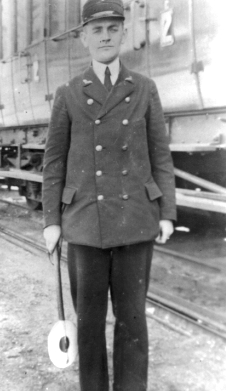
When my Dad was on the station staff of the old Rotterdam Delftse Poort station (now “Centraal”) I used to look in his coat-pocket when he came off night-duty for cubes of sugar he kept for me from his evening coffee. There is still a photo of my father in his Dutch Railways (NS) uniform with the continental-type departure staff in his hand standing next to a passenger carriage in the yard of the Rotterdam station. The station was badly damaged in the bombardment of Rotterdam (1940).
We used to live behind the station in the Harddravers st.22. My mother tells me that I used to put boxes and shoes all in a row on the floor to play trains and woe betide anyone who upset that row I was playing with. As far back as I can remember, I have had toy trains, and later, model trains in various gauges at home.
My grandfather began work in the railways in the last decade of the 19th century as a labourer in Eindhoven, the Netherlands. This place was rapidly expanding because of the burgeoning electrical industry being developed by Phillips, initially manufacturing light bulbs in a world that was rapidly changing from gaslight to electricity. Grandpa was soon in a signal box and as the railway yard grew and traffic increased all the time, he grew with the signal box in rank, retiring in the late twenties. Two of his three sons followed him on the railways, starting on stations near Eindhoven. Was this perhaps why I was attracted to anything running on two steel lines?
My father was a clerk, a “Commies” with the Dutch Railways (NS). In early 1928, he answered an advertisement for training as Sub-Inspector (or Assistant Superintendent of a railway district) with the Nederlandsch Indische Spoorweg Maatschappij (NIS), a private railway company with its head office in The Hague.
In those years, after the First World War and before the great world depression of 1929, there were often calls for European staff for the many colonial enterprises in what was then the Netherlands East Indies (NEI) and what is now Indonesia.
At the time my father was engaged by the NIS, the mainly European cadre of the company went to the Indies for 5½ years and then had six months furlough with a return fare for the employee and his family to the Netherlands. Yearly there was a vacation of two weeks, which was generally spent at some nearby mountain resort with a cooler climate.
Society was very much stratified in those days and one travelled on the weekly mail steamers between Indonesia and the Netherlands according to the level of society to which one belonged. The four different classes were fairly strictly separated on board. We always travelled second class, which was the largest class both in terms of the number of passengers travelling and in the space allocated to it on the ship. These ships were like floating luxury hotels.
The NIS headquarters were in The Hague where the Board of Directors had a small administrative support staff.
The office of the NIS Council of Management in the Indies, presided over by a Chairman, was in Semarang, the capital of the province of Central Java. This office was in an ornate building, which is still the regional office of the PNKA (the Indonesian railway administration), at the beginning of the Bojong (now called Jalan Pemuda).
The NIS network was divided into sections under a District Superintendent, the EDB (a telegraphic abbreviation meaning highest ranking official). The Superintendent was generally a man with a strong railway background in traffic and commerce and he had a team under him such as a loco engineer and a way and works engineer. In later years these people were drawn from university educated personnel in law and engineering.
Cepu, East Java: The NIS Network
My first recollection is Tjepoe (Cepu, East Java). It was (is?) a divisional point. My father was a Sub-Inspector in the traffic and commerce branch then. Cepu is now on the mainline of the Indonesian Railways, Jakarta–Cirebon–Semarang–Surabaya. But in my time, part of this present mainline between Semarang and Surabaya belonged to the NIS and was classed as a tramline at first, although it ran on its own right-of-way. More about the history of this line later.
There were extensive teak forests around Cepu which were served by the tramways of “Boswezen” (State Forestry). The Forestry had its own rolling stock of the 3’-6” (1067 mm) gauge. I think originally the teak logs were floated down the Solo River for export. There was also an oil field nearby exploited by a Dutch company (BPM — Bataafse Petroleum Maatschappij) which was later to become a subsidiary of Shell Oil.
Parties of railway enthusiasts visit Cepu nowadays (1995) to sample the operations of the trains of the forestry department.
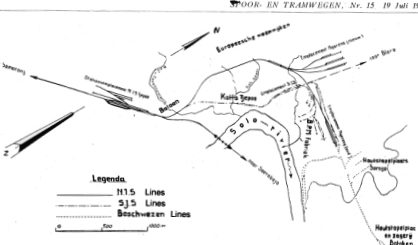
Some seventy years ago there was a lot of interesting railway working in and around Cepu. A colleague of my father wrote about this in the Dutch magazine, Spoor- en tramwegen (S&T) in 1938.
The SJS (Semarang Joana Stoomtram-maatschappij [Steam Tram Company]) reached Cepu in 1901 from Blora, while an NIS tramline of 3’-6” gauge was being built from Gundih to Surabaya. The SJS built a railway yard on the northern outskirts of Cepu and a short line into the town with a run-around siding. From its railway yard a siding curved east into the oil plant nearby, called Ngareng.
The BPM acquired some rolling stock of its own, bogey flat wagons to carry drilling material and a few 4-wheel open wagons. This rolling stock used the forestry department network to get to and from the drilling fields. The forestry department had its own rolling stock, consisting of locomotives, flat cars and some carriages to convey workmen.
The NIS opened its line from Gundih to Surabaya at Cepu in February 1903 and connected with the SJS loop siding in the town. The main NIS line continued towards Surabaya.
On 1 January 1914 the NIS opened a 3 km branch to Ngareng, which came off the connection between the SJS and NIS near a spot called Baloon and circled west of the town centre to cross the SJS line north of its goods yard to finish in an exchange siding with the tramway of the forestry department. In the exchange siding, a connection was made with the sidings of the SJS in the BPM oil plant.
From there on, the NIS did all the shunting at the BPM oil plant as well as picking up loads of teak and firewood from the exchange sidings, which were placed there by the locomotive of the forestry department. This change came about because the distance to Surabaya is shorter than to Semarang. Export loading in Surabaya was done at the quay-side, whereas in Semarang large ships had to stay in the roadstead.
North of the NIS/SJS crossing, the SJS made a siding that ran virtually parallel with the NIS exchange siding. This SJS siding connected with the forestry lines also and was used to handle loads of teak and firewood for the SJS network. Locomotives were fired with wood fuel as coal or coke had to be imported. The oil fields around Cepu produced a very good quality oil to be made into kerosene/benzine/white spirit with a little residue left, good for asphalt only.
In 1929 the forestry sidings were enlarged and a large saw mill erected. A weighbridge manned by an NIS employee was put in at Ngareng, two km from the exchange siding at Batokan on the forestry network, to weigh the wagons of sawn timber and firewood which had to be handed over, and to assess the charges.
The BPM built a new magazine and filling installations west of the SJS Cepu–Blora line, connected to the NIS line. These sidings were called New-Ngareng and were worked by a BPM-owned diesel-electric loco because of fire danger. The sidings at the oil plant were called Old-Ngareng. Thus rolling stock of four different concerns were at one time running over these lines.
On the 5th October 1914 a carriage for BPM employees’ school children was attached to the relevant NIS convoy that ran from Cepu station to (old) Ngareng. On 1 July 1915 similar convoys handled BPM office staff four times a day. As the industry expanded, more people travelled and by 1921 three carriages were needed in the convoys to handle the numbers travelling. But a new quarter was built for Europeans, away from the railway line. The BPM then started to run a bus for the school children, bicycles became more affordable, and these passenger services were gradually reduced. The school convoys were discontinued after the Christmas holidays of 1933.
In 1923 the convoys for office workers were reduced to two carriages and in 1937 to one carriage and on the 31 May 1938 they were discontinued altogether.
The world depression of 1929 took effect and the technical supervising staff of Traction and Way and Works were withdrawn (or made redundant). The NIS workshop at Cepu had most of its activities transferred to Yogya Lempujangan, where the NIS had its main workshop already for both gauges.
My father was transferred to Surabaya, with his office at the NIS station at the suburb of Pasar Toeri (Turi), a neat and well-kept station (Home station of NIS section b).
All NIS personnel had to suffer a cut in their salary or wages, initially of 10% in 1929, which was increased to a cut of 20 percent some months later. This depression hit hard in all sections of society and industry. The SJS had to go into receivership and remained as such till the Second World War. Many of the once busy sugar mills had to close production, thus considerably reducing the earning capacity of the tramway companies that did the transporting. Many people either walked or used the wild-cat bus services.
Surabaya & the OJS Network
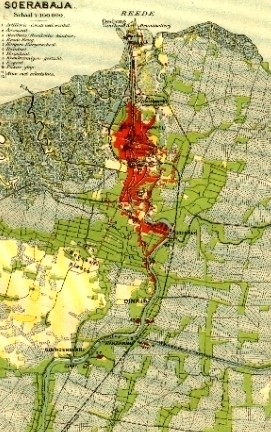
Surabaya has always been an export port for most of Eastern Java. Many private tramway companies served the export industry, mainly sugar, in East- and Central-Java. Surabaya was also the terminus of the OJS (Oost Java Stoomtram-maatschappij) and the SS (Staats Spoor — State Railway) which ran from Batavia, now Jakarta, to Surabaya via Yogya and Surakarta or Solo.
The OJS, an offshoot from the SJS, served Surabaya initially with a steam tram. The town line started at the mouth of the river Kali Mas on the eastern or right hand side of the river called Ujung. Here was the Harbour Master’s office, a ferry terminal for the island of Madura across the strait of Surabaya, a navy establishment and warehouses along the canalised section of the Kali Mas. The SS goods yard from which sidings served the warehouses was located at a military fortress, called Prins Hendrik (now Benteng = Ind. for fortress).
The town line then went to the SS passenger terminal station Kota, where a connection was made with the SS line. The town line continued then in a south-westerly direction across the Kali Mas and then south through the town along the streets and the west bank of the river to Grudo, where a workshop was built on the outskirts of town. From Grudo a country line continued for about 8 km to a sugar mill near Sepanjang. This was all established around 1890.
The OJS also had a steam tram line, which was separate from the town network, from Mojokerto to Ngoro with a branch to Dinoyo. This OJS country line served quite a few sugar mills and handed its loading over to the SS at Mojokerto for onforwarding to the port at Surabaya.
The town steam tramway was financially successful and by 1910 the company was considering electrifying the system, doubling the single line system, building a steam tram line around the built-up part for a goods line to a new development of the port on the western side of the river mouth, called Tanjung Perak. This goods line ran from the old town via Pasar Turi station along the western outskirts south to Wonokromo and joined there the country line. This was in place by 1916. This steam tram ran a passenger service which still exists and is a “must” for visiting railway enthusiasts.
The First World War delayed the electrification and as a first step a steam tram line was opened in 1920 to Tanjung Perak which junctioned off the goods line near Pasar Turi. In 1923 a connection with the NIS system was also made at Pasar Turi. During 1923, the OJS Surabaya electric tram system began operating. The route of the single line steam tram through the southern part of town to Grudo was then abandoned and an electrified double line took its place although following a slightly different route via the Palmenlaan (now Jalan Panglima Sudirman).
The OJS workshop at Grudo was at the end of a short line from Wonokromo where a new depot was built and the new electric tram line 1 through the Palmenlaan terminated. The steam tram through the western suburbs outlasted the more modern electric tram system by some six years until the early 1970s. It became in those years unique and often photographed.
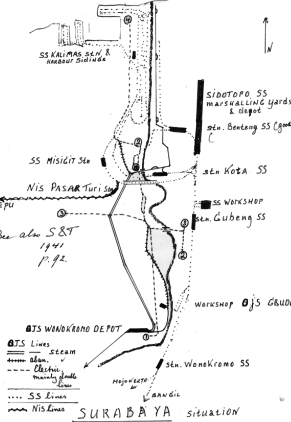
The main SS station was called Gubeng, from which the express trains leave. There is also Surabaya-Kota (town) station, located in the centre of the city. The main line of the SS came in to Surabaya on the eastern side of the river Kali Mas. Goods trains continued past Gubeng, the SS workshops and a junction to the Kota passenger station to arrive at the large marshalling yard of Sidotopo. Goods wagons for the eastern side of the river went then to the goods yard of Benteng.
Those for the western side of the river went back towards the Junction and took a high level line that opened in 1926 and crossed overhead a busy street at Pasar Besar, the Kali Mas and the OJS steam tram line Wonokromo to Ujung, to come down at the SS station Missigit. The NIS and OJS lines joined the SS lines at Misigit. The lines curved north here and crossed the OJS electric tram line to Perak, to finish in the goods yard of Kali Mas SS. From here sidings went to the new harbour basin and along the west side of the Kali Mas river.
On both sides of the canalised river Kali Mas ran a profusion of railway lines to the many godowns (gudangs). The area smelt strongly of sugar and molasses. My father had to go there at times to see Chinese traders regarding transport of products. I remember once when I came along, I was served a cup of green tea by Chinese traders.
I used to go to school by tram, taking line 1, which ran through the Palmenlaan (Jl. Urip Sumoharjo), a main thoroughfare, to the Darmo boulevard, from where it was a short walk to the Christian Brothers school. The trams were of the continental style, four-wheelers, painted a yellow-cream colour. They were built in Hanover (Germany). The trams had longitudinal seats and straps for standing passengers, and the floor was made of half inch slats.
Gauges, Rolling Stock & Operations
The railway gauge is 3’-6” (1067 mm) in most of Indonesia, except in the province of Aceh in Northern Sumatra (750 mm) and in my time, the NIS line Semarang to the kingdoms (Native states) in Central Java. This system had 4’-8½” gauge (1435 mm) and was called the broad gauge (breed spoor), whereas the “standard” gauge of 3’-6” was called the cape gauge (Kaap spoor from the gauge in South Africa).
The rolling stock of the SS and private companies was freely interchangeable. The standard 4-wheel goods wagon was 12 ton gross. There was a system of black circular markings at either end of the goods wagons to indicate the gross weight when this weight differed from the standard 12 ton.
Due to the tropical downpours, most wagons were of the closed type, four wheelers with a galvanised-metal body and a brakeman’s seat on the roof. Depending upon the gradients, brakemen were used as labour was cheap then. The SS had goods wagons with little roofed-over platforms at one end for the brakeman.
Before the invention of the Vacuum brake and the Westinghouse brake systems, brakemen were employed by the railways all over the world. Depending on the weight of the train, the gradients and speed, all railways had regulations on how many brakemen had to be carried in each section of line. These men acted on the whistle signals from the engine driver to apply or release the hand brakes of one or more wagons, thus assisting the driver to control a moving train.
The NIS locomotives fired teak wood and this firewood was carried in four-wheel slatted wagons to the various loco depots. This firewood came from the boles left in the ground after the cutting of the trees in the teak plantations and from the off-cuts from the sawmills. The centre-buffer coupling, the chopper type, was standard on the cape gauge.
Passenger carriages were end-loading with open platforms, except on some expresses, which had carriages with closed-in platforms. The NIS had a good number of four wheel passenger carriages in use, mainly in the 3rd and 4th class. A feature of many trains and trams then was the “pikolan wagen” or “pasar wagen” (market wagon), in which travellers could place their (often) bulky baskets. The bulk of passenger travel in the Indies was in the lowest class over short distances and mostly with bulky goods.
Passenger rolling stock of the SS and SCS (Semarang–Cheribon Stoomtram-maatschappij) was painted teak or brown originally, while the other private companies generally used dark green. The goods stock was predominantly black or the grey of galvanised iron.
Semarang: Head Office & the Broad Gauge
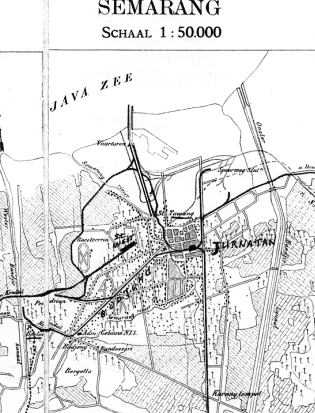
My father was transferred to the head office of the NIS in Semarang about the end of 1933. We travelled by train and I remember my first lunch in a dining car (nasi goreng or fried rice).
Our car, a huge old Fiat (the brand my father favoured all his life) was put on a flat car and came by goods train. The Fiat had a sailcloth roof which could be folded back. For inclement weather it had transparent mica panels to put in the doors. It had a horn with a rubber ball which one had to squeeze. When the Fiat arrived at the Semarang goods station of the NIS, I came along with my father and noticed the track and wagons being bigger on the other side of the goods platform. This was my first encounter with the “broad gauge” as it was called then.
The NIS built the first railway in Java in the 1860s. The line from the port of Semarang to Surakarta and Yogyakarta was built by the NIS to the European standard gauge in their new concession before the 1067 mm gauge was adopted in the colony around 1870. It gave the NIS a monopoly position for many years in Central Java, as in later years it effectively divided the SS system into an eastern and western region. The State started building railways in Java in 1875, beginning in Surabaya.
A condition of being granted the NIS concession in Central Java was building a railway from Batavia (Jakarta) to Buitenzorg (Bogor). This line was built to the cape gauge and sold later to the SS.
In later years, the government wanted to connect their two regions in order to run SS trains from Batavia (Jakarta) to Surabaya via Yogya and Solo. For through running, a third rail was laid in 1899 by the NIS between Yogya and Solo for which use the NIS was paid by the SS.
The third rail caused congestion in traffic and a separate 1067 mm gauge line was built next to the NIS line for the sole use of the SS trains during the twenties, opening for traffic in May 1929. It was called “vrije verbinding”, literally “free connection”. This line belonged to the NIS and the SS paid rental for its use.
The dual gauge line was then used by the NIS as it had built lines from Surakarta to Baturetno (1920) and from Yogya via Magelang to Parakan and Ambarawa in the 1067 mm gauge.
Three privately owned railway companies worked from Semarang. The Samarang–Cheribon Stoomtram-maatschappij (SCS) went west to Cirebon. It was a company that was called Stoomtram (steam tram) yet it had the status of a first class railway, and in later years had through carriages from Semarang to Batavia (Jakarta), which were handed over to the SS at Cirebon.
The SJS went north-east to Rembang and the country beyond and to Cepu. It was the oldest private tramway company and started off as a town tramway in Semarang.
The NIS, both cape gauge and broad gauge, went east and south, the cape gauge going to Surabaya and the broad gauge to Surakarta (Solo) and Yogyakarta.
Jurnatan station was the beginning of the SJS country services but also the city station for its town lines. It is a bus station now (1995) but in its days was an impressive station, completely roofed over, with four lines and busy with trams running all day. Lines went from Jurnatan to Jomblang (4.5 km, opened 1 December 1882), and Jurnatan to Bulu, along the main street, Bojong (3 km, opened March 1883).
Semarang is the capital of the province of Central Java. It is a port with a roadstead, hence lighters brought the export produce from the godowns to the ships lying in the roadstead.
The main station of the NIS was Semarang Tawang, a terminal station for both the broad and cape gauge of their passenger trains. It became the central station of Semarang after 1942. Semarang Tawang station was a large roomy building on a square at the edge of the older quarter of the city. In the square opposite the station stood (then) like all over the Indies a long row of “dokkars” (dogcarts — a two-wheeled vehicle pulled by a horse). My father had an office there at one time.
The port of Semarang, like Surabaya, developed along a canalised river, the Kali Semarang. Wharves and godowns, served by road and rail, were erected on both sides of the river. In Semarang a pier stretched out into the sea. There was also a harbourmaster’s office, a waiting shed for passengers, and customs facilities, called the “kleine boom”.
There were always ships in the roadstead, many of the Royal Dutch Packet (KPM — Koninklijke Pakketvaart Maatschappij) and its subsidiaries. These white ships with yellow funnels, such as the “Melchior Treub”, “Maatsuycker”, “Van Heutz”, were all named after former Governor-Generals of the Indies. These ships were floating hotels, in which one travelled overnight from Semarang to Tanjong Periuk to catch the weekly liner to the Netherlands.
During 1940 the SCS terminal station Semarang-West or Poncol was connected to the NIS Semarang-Tawang and Tawang then became the central station for Semarang. This enabled trains to run from Jakarta to Surabaya along the North Coast, shortening the distance and avoiding heavy grades in the mountainous backbone of Java.
In Semarang we lived in Kintalan Lama, where there were houses for NIS employees.
With my brother Henk, I explored around the Kali Semarang on the bank of which ran a 60 cm gauge line for about 3 km. This line belonged to a Chinese firm dealing in sand and gravel at Bulu. In the storage yard there were some curved sidings where the different types of river gravel and sand were dumped. This material was brought in by little trains of four tip trucks, pulled by a span of oxen. The line went through a kampong (native quarter) behind the storage yard, crossed the Semarang river at the Weir with the Wester banjir canal and then followed the river bank for a further 2 km to a site in a bend of the river where a lot of sand and gravel were deposited.
The driver of an empty tram would simply steer his oxen span to one side of the line and derail the four trucks clear of a full tram. When the full tram had passed, the oxen pulled the lot back on to the line again and the driver assisted with a long pole in rerailing the trucks. We hitched many a ride on those little trams.
It was around 1934 and I was nine years old then. My father was due to go on furlough after six years service with the NIS. Prior to embarkation for the Netherlands, the European employees were posted to Semarang Head Office.
We left soon for a holiday in Holland, but apart from some dockyard railway scenes at Tanjung Periuk, Singapore, Belawan Deli, Colombo, along the Suez canal, Marseille, Algiers, Tanger and Lisbon, I do not remember much. We arrived in Rotterdam and I remember seeing the first streamlined diesel train between Rotterdam and Dordrecht, when sitting in the train to Eindhoven, where my grandfather lived.
The railways in the Netherlands were mostly steam in the 1930s. There were still plenty of three-axle carriages used in passenger trains, some without lavatories, even on long distance runs.
I was very much taken with a shunting motor, that was recently introduced by the Netherlands Railways and was called a “sik” (billy goat). This one shunted intermediate stations and collected goods wagons. As my meccano set had four flanged wheels, I attempted to make a model of it, while staying with the family in Wolvega, where I saw this engine in action.
Surakarta (Solo): NIS Section II
My father was appointed to the NIS section II, home station Surakarta (Solo) and had his office at Solo-Balapan. The house that went with the position was in easy walking distance of his office.
In the 1930s, the world depression hit the State Railways and the private railway and tramway companies in the Indies severely. Private motorcars and wildcat omnibus services competed with the railway passenger services. Lowering passenger tariffs, more frequent and faster services were used to combat the road competition. Many mixed trains disappeared. In their place came separate goods and passenger trains.
On its most popular routes, the SS started running light trains at high speeds more frequently through the day. The NIS also increased the speed and frequencies of its trains. Passenger rolling stock was made more comfortable and brighter. In first and second class, air cooling was installed and there were early experiments with air-conditioning.
Thus on the broad gauge, five fast passenger train services each day were begun in each direction between Semarang–Solo–Yogya. These trains stopped only at a few intermediate stations. The carriages were modernised and the enclosed balconies were given a stream-lined appearance. These new fast trains were quite a success and I had a few trips in them between Solo and Semarang on our family pass.
In NIS Section II were two native States, the Sunanate ruled by HRH Paku Bewono X (PBX), the senior member of the House of Mataram; and the Mangkunegaran, a distant relation of the house of Mataram, whose ruler was called the Mangkunegoro. The Indonesians venerated these rulers with almost religious fervour and when these kings travelled about, there were always great concentrations of people making obeisances to them, squatting down and putting their fingertips together in front of their face (Sembah).
These rulers had their own armies, modern rifle detachments and old fashioned detachments, equipped with bow and arrow, lances or muskets and clad in armour. My father, as the NIS representative, had to attend court many a time.
At that time a change of Governor-General (GG) took place and the native rulers all travelled to Jakarta to welcome the new (and what proved to be the last) GG. For such an occasion, PBX travelled by special train, accompanied by his retinue and state sacred objects and jewellery. The Mangkunegoro travelled in extra carriages attached to the prestigious “eendaagse” (an SS express train that ran during the daylight hours from Surabaya to Jakarta via Solo/Yogya).
The GG then made a return visit, also by train. These train trips required elaborate organisation. For the GG’s visit, a special protocol book was issued, which laid down all the proceedings for both halves of the return journey, including where the train had to stop, who had to be on the platform to greet the GG, the order of the processions to the Kraton (palace of the ruler) and the Governor’s palace, and the timings of the events. All along the railway lines travelled by royalty, there were huge movements of people by rail in extra trains.
Solo-Balapan in those days was rather ornate, as the native rulers frequently used it for their travels. There was a large square in front of the reception building, and a huge, roofed-over crossing on the level of the cape gauge lines of the SS that brought one to the station itself on an island platform. On the other side of the platform, the northern side, was the broad gauge. The line from Semarang came in from the East and went on to Yogya.
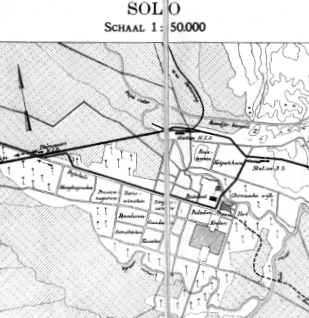
Between Solo and Yogya there is fertile country producing sugar cane (with many sugar mills) and also a particularly good tobacco leaf which was much in demand by the world’s cigar manufacturers as a wrapping leaf (“dekblad”).
Two cape gauge NIS branches went out from Purwosari. One went to Boyolali, serving sugar mills. The branch was originally built by the Solo Tramway Co. and bought by the NIS. This line went through Javanese countryside at its best, the heartland of a native State, terraced rice fields (sawahs) up the mountain slopes, small villages (dessas) everywhere. On a visit to Boyolali to the Regent (the highest native civil servant) with my father, this gentleman gave me the nail of a tiger he had recently shot.
The other branch line went to Baturetno. It crossed the broad gauge, the “vrije verbinding” and a main road on the level and followed this road as a town tramway into Solo, past the Kraton, to a station Solo Kota (town). Here it went on its own formation to Wonogiri and Baturetno, where there was a Japanese-owned copper mine which generated some traffic.
The NIS had also bought the Solo Tramway Maatschappij (STM), which had a line running from the SS station at Surakarta (Solo Jebres) via the town (Kota) and Purwosari to Boyolali, using horse traction on the cape gauge. The STM was a simple but fairly profitable affair from all accounts and was bought because it had the concession to transport the export produce of the sugar mills along its line to Boyolali, which it handed over to the NIS at Purwosari for onforwarding to the port of Semarang. The STM crossed the NIS line at Purwosari.
In contrast to the other lines of the NIS, where the safe working went by railway telegraph, the lines taken over from the Solo Tramway Co. were worked by telephone.
Nowadays with sophisticated electronic systems in use, it is difficult to realise how the morse telegraph system worked in conjunction with the safe working of trains on single lines. For a start, the operators had to qualify in the morse code, where a system of dots and dashes represented the letters and numerals. A wire between the stations carried the electric impulses of the dots and dashes, with the earth used as the return. A switch, called the morse key, was used to make the dots and dashes impulses and at the receiving end, these were printed on a long, thin band of paper, the ticker tape. Thus train orders were sent.
There was also an extensive vocabulary of words covering all business that could arise at a station, covering not only safe working of trains, but also relating to loadings, availability of wagons, seat and berth reservations, personnel management and many more matters. Once a day the standard time signal also came through, whereby the station clocks and watches were set.
As mentioned previously, many pedestrians used the railway lines and especially the railway bridges as short cuts. I accompanied my father once to a fatal accident, where a deaf woman was caught by a train. A policeman was gathering the remains, just a pathetic small heap of flesh. A few times I saw very near misses on the long railway bridge crossing the river near where we lived, when people could only just make it to one of the pylons and safety.
I went quite often with my father on his inspection trips, mainly by car, although once by train to Wonogiri. My father had to scold quite a few stationmasters along the line as the trains were often delayed by too much socialising of station staff with train crew, indulging in iced tea together.
Magelang & the Rack Railway to Ambarawa
Early in 1938 my father was transferred to section IV with the home station at Magelang. Section IV ran from the home signal at Yogya to Ambarawa, which included the only rack railway in Java and a branch from Secang to Parakan. A road freight service of the NIAB, a company’s offshoot, from Parakan to Wonosobo was also included in this management.
Accompanying my father on an inspection by car to Wonosobo, I saw a train of the Serajoe Dal Stoomtram (SDS) once. The loco had four coupled axles with a very long wheel base. I found out later that this was one of the SDS 201–205, with a wheelbase of 6900 mm and using Klien-Lindner axles. In this type of loco, the first and last axle can set themselves to sharp curves and at the same time such a loco is very easy on bridges, because the load is so spread out.
Magelang is a town which lies in a valley among the mountains Merapi, Merbabu, Sumbing and Sundoro. The Merapi is a very active volcano. Magelang was a garrison town, the base of an infantry regiment with a school for Warrant Officers. During the yearly military exercises (Manoeuvres), long military trains came and went through town.
Magelang is laid out on a South–North axis, and the first station was Magelang Pasar (Market). The line then went through the main street of the mainly Chinese business quarter to come to a halt called Aloon-Aloon.
The Aloon-Aloon is a square which one finds in most towns in Java. Along its four sides were the town’s most important hotel, government offices, a mosque, a Catholic and Protestant church and the official residence of the Regent, called the Pendopo.
The line continued through the main street of the European quarter, past the entrance of the military barracks and into the yard of the main station, Magelang Kota. My father’s office was in the yard grounds.
The branch line Secang–Parakan goes into the saddle between the Sumbing and Sundoro mountain. The climate is very bracing and the NIS has a beautiful guesthouse at Temanggung. The guesthouse was used by the higher grade personnel of the NIS. The grounds in front of the hotel fell away down to a mountain river and to the right was a huge railway bridge on the Secang–Parakan line. The scenery was Java at its best. This line has since been removed.
The line Secang–Ambarawa has a rack section to overcome the saddle between the Sundoro and the Merbabu mountains. The locomotives were built by Esslingen. There is an 8 km rack section here, with Bedono at the summit. From Gemawang (on the Magelang side) to Bedono is only a short rack section, circa 2 km, but from Bedono to Jambu is approx. 6 km. It is then another five kilometers to Ambarawa, called “Willem Een” by the NIS (named after a nearby fortress called after Dutch King Willem I).
Gemawang and Jambu are simple crossing loops with Gemawang having a short siding to a one stall loco shed. At Bedono is a nest of sidings and a turntable to turn the rack locos as these always have to be on the down side on the haul between Bedono and Jambu.
My father managed to get the carriages up front if we travelled on the rack, so we could stand on the balcony. The locos approached the rack section at about 5 km/h so the pinion wheel could engage with the rack, which is sprung for the first few meters so the loco pinion can match with the rack. On long trains, a rack loco was placed in the middle of the train also.
In Ambarawa at the PNKA’s railway museum, one rack railway loco is still kept with a few four-wheel carriages to be hired out on tourist trips as far as Bedono. The locals use the rack to run their little trolleys on. I saw this on a video sent to me by a friendly railway fan (1993). My brother Henk made a visit also to this museum and to Bedono in 1989. The line from Yogya to Bedono and the branch to Parakan are all closed now.
In 1939 Ambarawa station was an island station. On the western side of the platform was the cape gauge, on the eastern side was the broad gauge, and the end of the branch line from Kedungjati.
Nearby was also a huge swamp (Rawah Pening), drained by the Kali Tuntang. A huge dam in this river near Tuntang provided the water power for the hydro-electric works there. It was part of the concession for building the broad gauge from Semarang to the Kingdoms to build this branch (Kedungjati–Ambarawa) to provide transport for the garrison at Willem Een. When the powerhouse was built, the railway transported all the materials and there was a siding at Tuntang that led to the very steep incline to the powerhouse deep down in the valley. Heavy machinery could be lowered (or lifted) on the broad gauge railway wagon via this incline by a cable.
The barracks at Willem Een were used by the Japanese from 1942 to 1945 to house European women and children in the infamous women’s camp of Ambarawa.
On the 22 February 1939 a special broad gauge funeral train ran from Solo Balapan to Kotagedeh conveying the remains of HRH the Susuhunan of Solo, PBX. The train consisted of three luggage vans for the wreaths, the hearse, and twelve carriages of three classes for the mourners and court officials. Millions of people travelled from all directions to stand along the line this train travelled, some 80 km. My father had just acquired an 8mm movie camera and I still have his film of the funeral train and the procession at Kotagedeh.
Departure & the Return to Europe
At the end of 1939 my father was due for furlough in Europe again. As I was due to start high school in Europe at the end of August, our family went ahead of my father to Europe to spend the summer there.
I travelled ahead to Semarang by train while the family came by car. By then we had a new Fiat 1500, bought in Solo in 1937. As the train started to climb out of Secang, I looked back towards Magelang and had a feeling I would never see this again.
I left my faithful dog “Juno” behind after some four years with a Mr. Chevalier, who ran the local cordial factory in Magelang. Mr. Chevalier was a veteran of the French army in Salonika during the First World War. Juno wouldn’t take to anybody else and in the long run had to be destroyed I was told.
My family arrived a day later and we stayed in the Hotel “Du Pavillion” in Bojong, pending the departure of the KPM ship “Melchior Treub”. The transfer from the Kleine Boom to the ship in the roadstead by launch was a thrill, the small launch bobbing up and down in the swell and the prospective passengers trying to jump from the launch onto the bottom of the gangway of the big ship.
We arrived in Tanjong Periuk, harbour basin 2 and were transferred by launch to basin 1 where the mail steamers left for the Netherlands. We were travelling on the MV “Indrapoera” of the Rotterdam Lloyd line. We had a run into Batavia (Jakarta) with an electric train from the SS, which ran a suburban service here from the harbour to Bogor. In those days there was also an electric street tramway system, which employed a gauge of 1188 mm. This street tramway system was originally run with fireless engines, but that was before my time.
The departure of the weekly mail steamer was always a big occasion. Boat trains ran to the quay from which the ship left. Leaving in the afternoon, an overnight sail made a morning arrival in Singapore, where we passed the huge battleship “Malaya” lying at anchor in the roadstead. At the dockside I looked at the quaint-looking rolling stock of the “Federated Malay States railways” (the FMSR, metre gauge).
Another overnight sail brought us into the harbour of Belawan Deli on the island of Sumatra, where we took a train to Medan for a drive around in a taxi. I also took a picture of a 2-4-2T, which the private Deli railway company (DSM) had acquired from Germany, built by Hanomag in 1928.
Sumatra had three State railway systems, two in the cape gauge and one in 75 cm gauge in the north of the island in the Aceh province. The private Deli Spoorweg Maatschappij (DSM) had some 550 km track in the cape gauge and served flourishing plantations in tobacco, rubber, tea and palm oil, transporting their products to the port of Belawan Deli.
Nearing Marseille, we saw a large number of French navy ships on exercise. We disembarked at Marseille and got a 2nd class compartment in a PLM coach of the “Lloyd Rapide”. Just out of Marseille I saw a local train made up of three-axle side-door stock. In Lyon we saw huge numbers of French soldiers on the platforms. Signs of war! We shunted around Paris in the middle of the night.
These boat trains were organised in the late twenties by the two Dutch shipping companies to expedite travel to the Indies, cutting travelling time to 3 weeks by ship from the Mediterranean ports of Marseille and Genoa. This overnight journey also avoided the long haul around the Iberian Peninsula and the crossing of the notorious Bay of Biscaya.
We got off at Roosendaal where the customs visitation took place and changed trains to go to my grandfather’s place in Eindhoven. We then went to live at Heerenveen in Friesland. Although war was threatening, it was a terrific time for me travelling on and seeing different trains and trams and soldiery, but this is a different story. Although I didn’t know it then, the times would change very much, beyond what we could imagine.