
Sydney: Railways Department & Overhead Wiring (1954)
Early in January 1954 I returned to Sydney from my trip to Chinchilla. I went to my nearest Commonwealth Employment Office at Bondi Junction where I was told that one had to be a naturalised citizen to work on the Government Railway (NSWGR).
On 13 January 1954, I went into the city, to Central Station and walked over to the Railway Office in Pitt Street, to see if there was any labour required. In those days there were boards up everywhere on the walls of factories, stores, etc., asking for labour. There was nothing of that at this railway office and as I walked away, an Italian man asked me the way to the Railway Employment officer. He had a note from an Employment Office to present himself there. I showed him the way and followed him in too.
At the fifth floor was a large waiting room and one had to fill in forms. Later on I was asked to do a simple arithmetic test, and later still I had hearing, vision and physical examinations. I was asked if I wanted to be a “porter”, which I thought was a “redcap”. I declined that job in favour of something mechanical, whereupon I was given a letter to report to the Electrical Engineering Branch in York Street. I went there and was shown into an Engineer’s Office where I was asked to read an English text. I was then told to report for work at the Leichhardt Depot of the Overhead Wiring Branch. This depot was adjacent to Pioneer Park (a former cemetery) and included a bus depot as well.
The influx of nine people must have baffled them at the depot, as someone remarked that only six months before quite a few had been laid off and now they didn’t know what to do with the newcomers. Many were Italians back from canecutting in Queensland and working in the city for the slack season. We were set to clean the yard which lasted for a week. Six of us were then sent with old Mac (McEvoy, who had one lung) to test some poles along the Chullora line. We were issued with a tramway pass and initiated in the various names (up and down lines, six foot and four foot) of the railway lines. After this we had a simple examination for flagman.
I then went out with a gang repairing overhead wires, mainly with George McLennan, and sometimes with others, and we worked all over the Metropolitan area.
The electrified area stretched then only as far as Hornsby, Parramatta, Liverpool and Sutherland/Cronulla. They were working then on the electrification to Blacktown. We worked for an extended period in the Lidcombe–Auburn area where the track was being equipped for 4 electrified lines. For a time I worked around the Georges River bridge (the old one with gauntletted track), along the Illawarra line, East Hills and Bankstown lines.
Once I had to relieve a flagman from an emergency squad working from the Prince Alfred Depot. The emergency squad consisted of a lineman and offsider and two flagmen. We had a truck with radio and all necessary repair gear. The squad was directed to any trouble in the electrified area and I remember I had to flag in the peak hour just past Redfern station towards Macdonald Town, because of a broken “dropper” (a thick copper wire that holds up the catenary from the carrying cable). At this spot were some 8 electrified lines and some more goods lines. Trains were running everywhere and at one stage I had to lie in the six foot as two trains passed one another at speed.
I was mainly flagman and my job was to protect the lineman working on his ladder. Depending on the line (fast or slow), I went out for some 1200 yards, with detonators, a whistle and two flags, a red one and a yellow one. When I saw a train on my line in the distance, I blew the whistle and watched the other flagman, who gave his yellow flag when the working men and their ladder were off the line. I showed the yellow flag then to the driver of the approaching train. The driver knew then there were two detonators lying on the rail also. These detonators went off with a very loud report.
A few nights I also went out on a cable train. The train consisted of a steam locomotive pulling a flatcar with a huge roll of catenary wire on it, followed by a dozen or so old carriages, which had a gangway on top of the roof. On the gangway of each carriage stood a couple of linemen and as the train went slowly forward and the catenary wire unreeled from the roll, these linemen fastened the catenary to the droppers. At the final carriages the ganger and engineers checked all work and I stood near the ganger and swung my green light steadily toward the driver of the loco. This was done midway between Strathfield and Central.
The power on the catenary is 1500 volt DC and one night I saw a powerful flash, when a lineman’s spanner touched an overhead bridge at Auburn. The lineman burned his hands but did not fall off the ladder. The immediate area was momentarily lit up to daylight.
However as time went on this job became boring and I did not feel like being a lineman so I asked to be transferred to the traffic branch. The office tried to delay this transfer as long as possible till I threatened to resign. But it was a good experience as, by now, I knew the railways of the entire metropolitan area.
NSW Traffic Branch: North Sydney Station
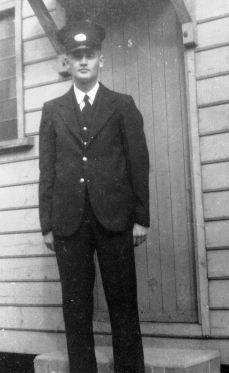
I had to go through all the tests again and was sent to the traffic office in Central Station, where they showed me all over the place in the morning, including the tunnels, platforms and lifts. The next day according to the roster I had to start at Darling Harbour Goods Shed. I didn’t like that idea and asked for a station job and after a bit of dilly dallying I was sent as a third class relief Porter to North Sydney. I was given a cap and a uniform at Rozelle and issued with the Rules and Regulations and its appendices.
At North Sydney I reported to Station Master (4th Cl.) Mr. Rich. The first day I was placed at the barrier with another relief man to learn the new job. I was issued with a rail pass also. I did this for a week in the 7 am to 4 pm shift — barrier, concourse cleaning, assist the platform when the trains were stabling after the peak hours.
I worked here for some six weeks, then at Hurstville for two days on the barrier and platform and at Como for a day where I sold my first tickets (£1-10-0 worth).
Mr. Rich asked me then if I would like to take a first class relief Station Assistant’s job, provided I went through all the examinations for Safe Working (signalling) and all aspects of station working. This was to replace an English man, Leonard Trip, a former Guardsman, who got a job at Fairy Hill (near Casino) as a 7th class signalman.
I had three weeks to learn the job, which was to relieve all positions at North Sydney during a fortnight.
Every Monday I had to start early at 4.50 am at North Sydney to sell weekly tickets, some £250–£300 in 3 to 4 hours’ time, especially between 6 am and 8 am, when the booking clerks came on the job. My knowledge of all the lines and their stations came in very handy, because that is the order the tickets are located in the big rack next to the ticket window.
There were two types of weekly tickets, the workman’s weekly and the weekly season ticket. One had to stamp them with the number of the coming week. There was a deposit of 1/- on such a ticket. This was a high pressure job as between six and eight there was at times a queue stretching from the ticket window to the stairs in the concourse.
At nine o’clock I closed the window and balanced the cash and sorted the tickets in their station order for auditing.
I also did all the other relief jobs in North Sydney, and sometimes I was called out if somebody reported sick. Everybody worked a 13 day fortnight. They all liked the weekend work for the penalty rates so I never had to relieve somebody on a Sunday or Saturday, but was at the disposal of the fellow of “Control” in Sydney Central, who could send you all over the Metropolitan area to relieve Station Assistants as Porters were now called.
The morning shift started at 4.50 am on 1/2 platform and one worked also 3/4 platform till 5.30 am when the other chap came on. We quickly swept the platform and picked up papers along the line. Around 6 am the trains started to come quickly, one after another, and by 7.30 am they came every two to three minutes. For this peak the Boss (Mr Rich) usually came down to oversee things and give a bit of a hand. The trains were whistled off on time. One showed a white flag to the guard, who rang the bell for the driver to start. One had to watch the indicator light on the platform to see if the signal ahead was off, giving a clear track.
The signalbox at North Sydney was worked by track block automatic signalling and in its day, it was a showpiece as it was the first of its kind in the system equipped with pistol-grip handles instead of the large levers.
The 11 pm backshift was done all the time by a man who was a jockey during the day. In this job you took over a ticket window from a junior booking clerk and from midnight you also did the platforms. At one o’clock you started to hose down the very modern lavatories as by then there were hardly any people about, apart from an occasional drunk. Then there was a spell for about two hours in which I did my correspondence courses, which I got from the Railways Institute. At 4 am the first train ran again and guards and porters started to sign on. At 6 am a booking clerk came on to take over the place.
The jobs starting at 8.15 am and 3.30 pm were at the North Sydney car sidings, behind the Luna Park. This was the original terminal station on the North Shore, before the Harbour Bridge was built. In those days the steam suburban trains from Hornsby used to finish here and people caught ferries across to the city.
Once a month a steam engine with 2 S trucks full of brakeshoes and a brake-van came down to the NS car siding. As there were no loops there, the shunting was done by gravity, as there was plenty of slope in the line there. Occasionally a steam train came into NS at night time with a ballast train or to pick up rubbish. These were usually extensions of a goods working at night to St. Leonards.
A typical fortnight’s relief work at North Sydney was: Monday 4.50 am weeklies, Tuesday 4.50 am platform 1/2, Wednesday 5.10 am platform 3/4, Thursday 8.14 am NS car siding and platform 1/2, Friday 4.50 am platform 1/2, Saturday 4.50 am platform 1/2, Sunday 9 am Staff Office (Soff) at Central (to be available wherever wanted), Monday 4.50 am weeklies, Tuesday 8.14 am NS car sidings and platform 1/2, Wednesday 5.10 am platform 3/4, Thursday 11.4 pm backshift, Friday ditto, Saturday 4.30 pm platform 1/2, Sunday off.
When I got the North Sydney SA 1st Cl. relief job, I sat for an exam every week at the Railway Institute. The various subjects covered safe working (signalling systems), shunter and guard duties, station management, coaching- and goods-accounts, English and St John’s Railway Ambulance 2nd year. The English test was a dictation test, taken from a railway manual, and in which my only mistake was the word “haul” which I wrote down as “hold”. At the end of the exam, the examiner held me back, as he was curious about how I performed so well.
As soon as I had passed all the safeworking systems I was offered 7th class signalman’s jobs and I was appointed to Camira Creek (between Grafton and Casino) because a house went with the job. But I never got to Camira Creek as I qualified in the meantime in all the exams and I was offered 5th ASM jobs.
Almost once a fortnight I was given a job by the Soff at Central and this took me all over the Metropolitan area. In the beginning I had some difficulties, especially before I had done my safeworking exams. But later on I was given any first class SA job that came to hand and I had some good and interesting jobs, ranging from sitting all day at Soff to emergency jobs in the Metropolitan area. I did booking offices at Clyde, Roseville, Como, Meadowbank, Petersham, Woolooware, Pennant Hills; platform porter at Roseville, East Hills, Lakemba, Wiley Park, Homebush, Strathfield and Hurstville; Barrier porter at Sydenham, Auburn, Lidcombe and Central.
Bomen Station: Life at a Country Crossing (1955–56)
In May 1955 I got married and we went to live in a room at Neutral Bay and I could ride to the job then (although there was a very steep hill on my route).
10 November 1955, before I got to Camira Creek, I was appointed 5th ASM at Bomen. On Monday 31 October 1955 Joyce and I went by Riverina Express (8.15 am ex Central) and arrived at Wagga Wagga at 5.30 pm. The next morning we went by goods train to Bomen.
Bomen station was around 1870 the terminus of the Southern railway, till the bridge was built across the Murrumbidgee river and Wagga became the temporary terminus then. The station building was built of brick in a contemporary design, as was the SM’s house near the station.
I had a week to learn the job from Vic Dooley, who had been appointed as 4th ASM at Glencoe (New England), on the line to Tenterfield & Wallangarra. His boy used to play “changing staff” on the platform!! I was going to take over the cabin and two tents he had hired from the department and the wire netting fence he had erected around the cabin and tents.
The abattoir at Bomen had a siding that came off the Bomen goods siding and furnished one or sometimes more insulated and iced bogey vans of meat a day and at times a truck of hides and/or tallow outward and a truck of coal inward as the main business. There was still a little coaching traffic, an occasional crated pig or poultry or fruit, and a few people and pupils from the nearby agricultural college travelling.
Train working was the biggest job at Bomen. The day shift was done by a 4th ASM, Eric Haslam, who lived in the SM’s residence. Among his train working was no. 7 Albury Mail, 36 Riverina Express, 406 fast goods usually headed by the new 40 class diesels and a 50 class steam loco double-heading and three times a week a midday passenger train/railmotor Junee to Wagga.
Even numbered or Up trains went to Sydney and odd numbered or Down trains moved away from Sydney. Trains numbered in the 400s were diesel hauled.
All the express passenger trains were on automatic exchange, that is one had to set up a “catcher” next to the track in front of the office. The top of the catcher had a clip that held a stout leather pouch hanging on a metal ring. In the pouch went the staff for next section. On the tender of the engine was a similar device upside down and when these two catchers met with a bang, the tender catcher caught the next staff and the station catcher caught the previous staff. The staff gives the driver authority to go into that section as no-one else can get into that section then. The staff instruments between two stations were worked electrically by the ASMs with a bell code and could only release one staff at a time, thus securing the section between the two stations for one train only.
The diesel-hauled fast goods trains were hard to exchange staffs with. On a steam loco, the fireman left the firebox door open and one could see the fireman and his hoop lit up by the glow of the firebox. But a diesel was pitch-dark. The driver switched off his headlight so as not to blind the officer on the exchange platform, but the diesel’s cabin was pitch-dark and only two little white headlights showed the train approaching, and fast did they come too, down the hill. I was hit once over my knuckles with such a cane hoop and after that I used a pair of gloves to change staffs with those diesel-hauled goods.
Then we had the Murrumbidgee flood and all of North Wagga was flooded, which stopped the highway traffic. All this traffic came to Bomen to be loaded on rail for the few kilometers to Wagga. Every morning Eric Haslam had 60 cans of milk to load on no. 7, which delayed that train each day of the flood for some ten minutes or so.
Norm and I did the train working, 12 hours a day, for a fortnight, while Eric did all the bookwork. After that we had a huge pay and we three got gloriously drunk in North Wagga.
We had a small cabin and two tents joined by a fly. Joyce always came with me to the afternoon shift. In the office in winter there was a huge open fire, and electric light to read by. I did some O gauge railway building in between trains as I could solder in the office. There was often someone to chat with, guards, firemen or drivers of crossing trains.
Bomen was an ideal place to do trainworking, and I had pilot working and proceed orders as well as fog signalmen out at one time or another. I learned a great deal there at Bomen.
Two weeks before I left all signal lights were electrified!!!
Two weeks after I arrived at Bomen I accepted a job as ASM Gurley, near Moree in NW NSW, then a 4th ASM job and became a 3rd ASM. But it took me over a year to get there.
Gurley Station: Pastoral NSW (1956–57)
The transfer to Gurley in October 1956 was similar to the transfer to Bomen. We left by no. 7 to Wagga and by no. 36 for Sydney and had four weeks leave in Qld. We came back via New England and Werris Creek, where I met all the staff at the District Superintendents office (the DS) who I had to work with, while we had to change trains. (3 Nov. 1956)
We had a Railmotor (RM) to Moree and arrived at Gurley at 8 pm and soon found our furniture, etc. at the residence.
I had two days to take over from a relief officer. He wanted to leave early on holidays and wanted to catch the mail which didn’t run the next day, so he left that afternoon.
Once we got the office going, I attended to the yard, where traffic was light. I had to collect quite a few outstanding accounts on the ledger, and it took me some time to know who was who, as the area was settled by a few families. I never saw much of my customers, as most dealings were done by telephone or correspondence.
Before the Second World War a travelling porter used to come out during the wheat and wool season, but this job was abolished during the war due to the labour shortage and never restored for lack of money. So I was on my own.
After the war the large Gurley pastoral station was cut up for soldier settlement, hence quite a lot of goods (fence posts, wire, machinery) arrived to help establish these people on the land. Their first wool in bales was exported by rail.
Huge tarpaulins had to be regulation folded on a windy plain. Like at sea, one could see the sky meet the earth there. Then these heavy tarpaulins had to be carted to the platform.
A lot of truck ordering went on by big pastoral companies via the DS Werris Creek, and one saw a huge mob of cattle or sheep come over the horizon and anything up to thirty cattle wagons arrived to be loaded. I had to get these trucks one by one at the cattle race, and after they had been loaded, dropped down a dead-end siding to be coupled up and ticketed, ready to go.
Gurley was also a receiving depot for the NSW Wheat Board and there was a large wheat stack there, harbouring huge flocks of galahs, mice (we had a mice plague there) followed by snakes. Bulk transport of wheat was just being introduced.
Gurley was (and still is) a small place. (Tom) Tramby and (Bill) Hanks were the local stock and station agents, Tom doing the office work and Bill doing the carrying. Joyce and I got on well with them and they were a big help and a mine of information. When I left they presented me with a cigarette lighter, which I still have.
I had a break-in in the out-off shed, and two cartons of wine disappeared. The policeman at Belatta came out to investigate, with no result.
I even had a breakdown of the ordinary staff system!!! Railwaymen growing old in the service cannot recall that ever happened.
On one of my last mornings at Gurley I came on duty to find two failed goods trains in the yard, the engines had their fire drawn and there was a note saying that an engine would come out of Moree to pull the lot in. I took photos of the proceedings and gave the film roll to the guard for developing but never got it back.
My brother-in-law (Roley Smith) came over from Queensland with his truck to cart our belongings to Brigalow in Qld. There were no bitumen roads in those days and we had a terrible trip lasting all day.
I managed to see a bit of the Branch line Moree–Boggabilla and the junction of the Mungindi branch at Camurra.
We stored all our belongings in a vacant house on Roley Smith’s property in Brigalow. We went to live in South Brisbane. I tried to join the QGR but had no success, I think they were trying to shed staff at that time.
Queensland: Brisbane's Trams & Branch Lines (1957–62)
So I started working in a factory at Rocklea, catching the Salisbury tram in Stanley Street at South Brisbane. Along Stanley Street there were warehouses, a fish depot and flour mills, all served by rail. At the five-ways the tram turned into Logan Road. The rail activity of both the trams and QGR at Woolloongabba have been well recorded.
On weekends Joyce and I took trams to a terminus and walked across the suburbs to another terminus to go back. Some Saturdays we caught the train to the end of a branch line. Most branches closed in the early sixties. Thus we had runs to Beaudesert, Lota, Ferny Grove, Shorncliffe and Dugandan.
At Newstead there was a funicular to the Cloudland Ballroom, both long demolished. The trams had huge depots at Ipswich Road, Annerley, Paddington and Light Street. Little signal boxes worked the points in the Valley, the five-ways at Woolloongabba and at Countess Street, Normanby.
The Saturday race traffic to Doomben or Eagle Farm and the showground traffic showed how trams could shift people.
There were two types of trams, the latest Phoenix type, silent and fast and the Californian type. During peak hours one could see occasionally a “Dreadnought”, a very old bogey type tram.
The trammies wore the famous “Foreign Legion Cap” (now a collector’s item).
In 1963 there was a huge fire in the Paddington tram depot that destroyed all the trams stabled there. It was one of the reasons to close down the system and replace it with buses. The trams can still be seen at the tram museum at Ferny Grove.
All long distance travel to visit Joyce’s family in Chinchilla was by train. This train left at 8.15 am from Roma Street Station, platform 1. At Helidon one could take a bus to Toowoomba and wait for the train to come up the range, very spectacular but also very slow.
Toowoomba was a busy railway station then. At lunchtime the overnight Sydney train came in via Wallangarra. The huge and ornate lunchroom was very busy. Later that afternoon there were railmotors going to all the different branches on the Darling Downs, viz Crows Nest, Meringandan, Cooyar, Haden, etc.
We had also travels to Hervey Bay, via Maryborough: an eight hour trip, now done in three hours by car. At Baddow the Bundaberg Mail set back into Maryborough. We caught there the afternoon train to “the Bay”, which had very old carriages — in fact one still had gaslighting!!!
The carriages were all wooden cars, open windows and balconies. Other features were the fan, water bottle and a glass in each compartment.
Once in Toowoomba we saw the first air-conditioned train on display. Delays were often a matter of course.
Before I came to Australia I had bought a kit for a mogul (2-6-0) live steam loco from Bassett-Lowke. This was “O” gauge (7 mm to the foot scale). Arriving in Sydney I came in contact with an “O” gauge house in Ashfield (the Stewarts). In Bomen I started building a portable track, extending it in Gurley. Shifting to Queensland I temporarily stored the “O” gauge with a brother-in-law and in Brisbane living in a boarding place I started an HO layout (Triang) as it did not take so much space.
In Scarness I had a nice layout then featuring also a tramway. When I bought my own place in Apple Tree Creek I set up my “O” gauge track again and gave the HO equipment to my brother in the early sixties. He is still in the hobby (2006) with a huge continental layout in his house.
In 1962 I joined the Post Master General’s department as I needed a more permanent job when the family came along. I went to the training school for Postal Clerks in Brisbane and worked in post offices around the suburbs.
I had by then joined the Australian Railway Historical Society (ARHS) Queensland Division also (1960).
I was for a year (‘63–‘64) the secretary of the Qld. Division of the ARHS, relinquishing the job upon my appointment as postal clerk in Mourilyan and later (1965) in Ingham.
From 1962 to 1965 I participated in all the ARHS tours of the Qld. Division, of which I kept the route descriptions, my rail tickets and photos. This was at a time when many branch lines were closing in Qld.
30 March 1963, RM Roma Street to Whinstanes, with electric haulage at the abattoirs. 7 Dec. 1963, Bundaberg to Tirroan with 99 year old A10 (Watawa–Tirroan & Return). 21 March 1964, Roma Street to Marburg, closing section Birru–Marburg. 26 April 1964, Sth. Brisbane to Nerang, last passenger train. 28 June 1964, Sth. Brisbane to Southport. 17 January 1965, ARHS special up the Kuranda range from Cairns.
North Queensland: Sugar Mill Railways (1959–1970)
I arrived in Innisfail early one morning on the “Sunlander” in August 1964. All sugar mills in Queensland, some 27 then, were working and transporting record tonnages in cane and export sugar. The industry was changing over from cane cutting by hand of whole stalks to machine harvesting. Bagged sugar was being replaced by bulk transport, and steam locos gave way to internal combustion engines. The timber-made canetruck with the hook and link coupling was being replaced by binns on roller bearings and the Willison automatic couplings.
My time in North Queensland was most interesting as I came at the tail end of the old era and the beginning of the new. I met old men who were at the start of opening up of that part of the country and I feel fortunate that I recorded their history in writing. I explored by bike and on foot the tramlines of sugar mills and mining enterprises and wrote a book (“The Innisfail Tramway”) with another old-time ARHS member, John Armstrong. I wrote several articles on these tramways for the bulletin of the ARHS and the Light Railways Research Society of Australia for their quarterly magazine “Light Railways” (no. 32 of winter 1970 “to Rocky Bluff” and no. 30 of summer 1969 “Stannary Hills and Irvinebank Mining Tramways” and “Rocky bluff to Denmark”) detailing its histories.
I cooperated with other ARHS members (Mike Loveday a.o.) in rescuing and preserving tramway relics in the hinterland, going every Easter weekend to Mike’s property in Mareeba to oil all old metalwork prior to dispatch to museums in the South.
In 1958 we moved to Scarness (Hervey Bay) to live with my mother-in-law as Joyce was pregnant. I worked here as a builder’s labourer till Isis Central Mill started crushing (1959) when I got a job on the locos at that sugar mill. I bought our first place at Apple Tree Creek then because of the shift work on the locos. I managed to get enough time in to sit for an exam for “locomotive and traction engine driver” (no. 2839 of the Qld. Machinery Dept. on 1/12/1961). I received a certificate to drive diesel locos in 1960 (no. 16629).
I refer for my railway writings about Isis Central Mill to the magazine “Light Railways” of the Light Railway Research Society of Australia, nos. 37 of Spring 1971 and 40 of winter 1972.
In January 1968 we had a big flood in Ingham whereby a road bridge was washed away. The CSR Company ran a passenger service and car transporters over their rail bridge across the Herbert river for some weeks, wearing out a few of their Simplexes hauling passengers and motor vehicles on their timetabled trams between Vella’s and Sheahan’s sidings on the Ingham–Abergowrie Tramway.
Until the 1930s there was a council tramway between the Port of Lucinda to Ingham and beyond.
Having spent such interesting times in north Queensland, by 1970 I felt really at home there and will recount that in the next period.